New medication started
Did the patient start it? Are there questions, barriers or new concerns?
KnowMediQ for community pharmacies
KnowMediQ helps community pharmacies structure between-visit follow-up after important medication and care moments — so pharmacists can see who may need attention, understand why, and act with the relevant context in one prioritized workflow.
The Québec pharmacy context
Medication therapy monitoring is already a core responsibility of pharmacists in Québec and continues throughout the medication-use cycle, including renewals.
When pharmacists initiate or modify therapy within their scope, professional guidance requires an appropriate follow-up plan and documentation in the patient record.
Beginning December 9, 2026, pharmacists’ scope in Québec is scheduled to expand further in areas including prescribing, prescription extension, substitution and medication administration.
Sources: OPQ Standards of Practice · OPQ practice guidance · OPQ scope update
Where the work gets fragmented
Did the patient start it? Are there questions, barriers or new concerns?
What changed after the dose or therapy adjustment?
Does the patient understand the medication plan and what comes next?
Is the issue understanding, side effects, routine, access or something else?
Does an authorized caregiver have information that may help complete the picture?
Does it need routine guidance, pharmacist review or another care professional?
The challenge is not simply collecting more information. It is knowing what deserves the pharmacist’s attention and keeping the next action visible.
From care moment to follow-up
A patient enters a configured follow-up pathway after an appropriate medication or care event.
KnowMediQ conducts the scheduled patient check-in according to the configured workflow.
Responses, questions and potential concerns are organized into usable context.
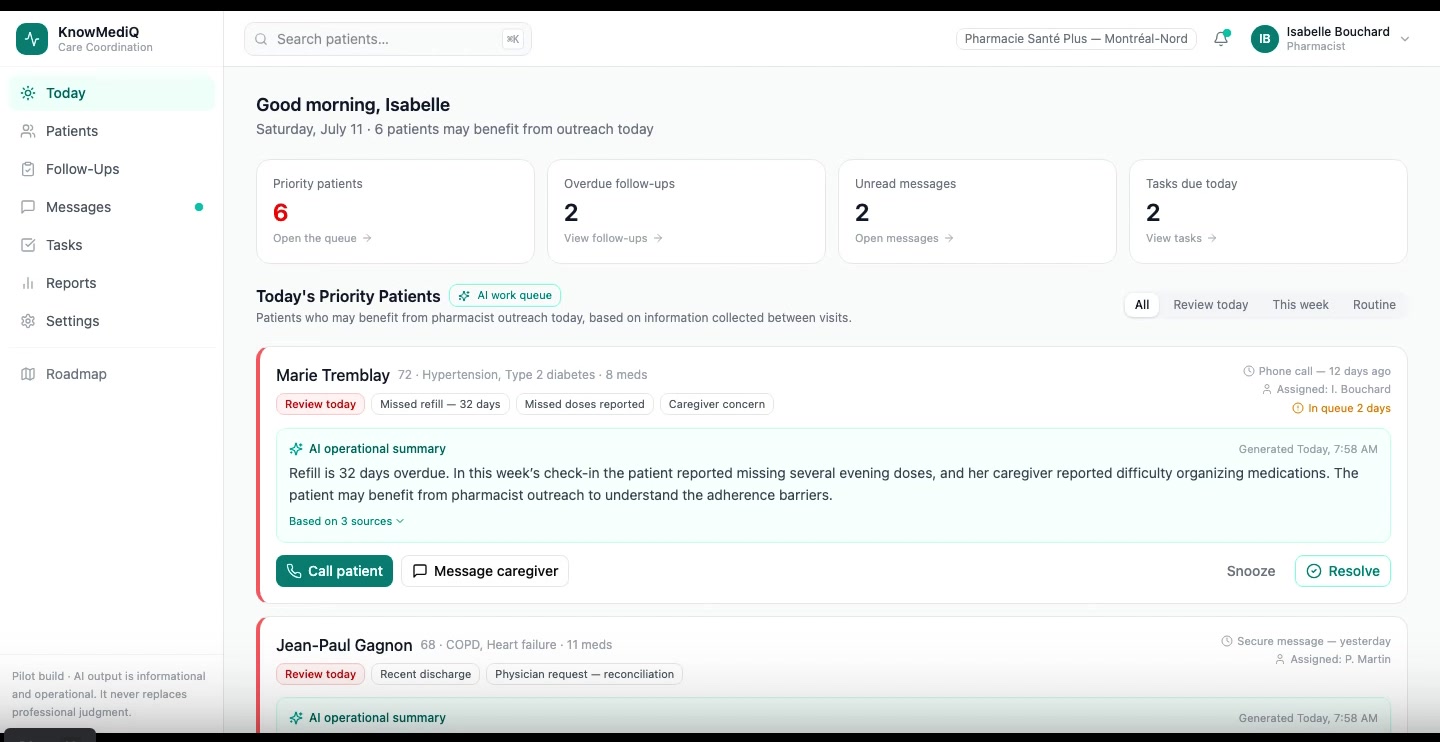
Patients who may need review appear in a prioritized work queue with relevant context and next actions.
The pharmacist applies professional judgment, completes the appropriate action and keeps the follow-up moving.
Configurable pharmacy workflows
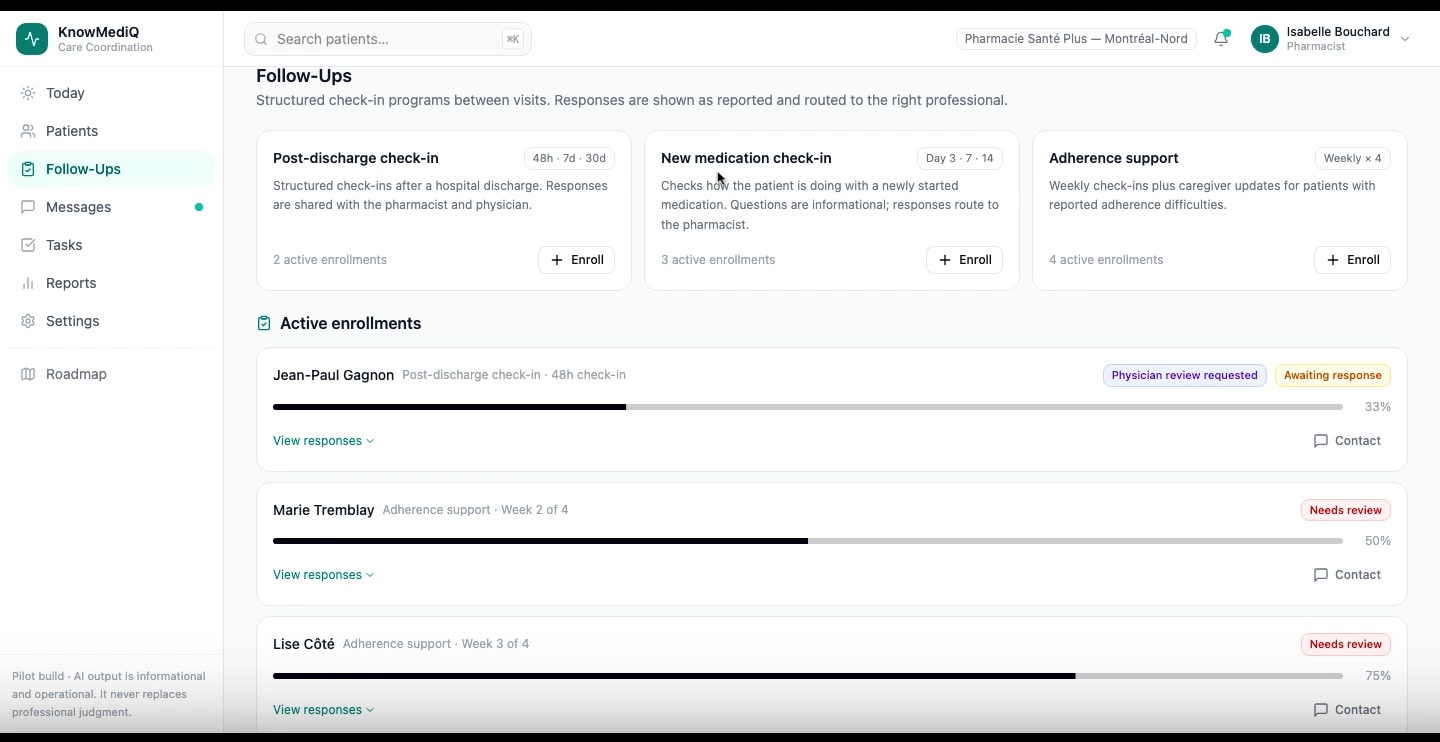
Structure follow-up after a patient begins a new medication or treatment plan.
Help maintain visibility after a transition back home when medication questions and next steps can emerge.
Create structured check-ins around medication-taking barriers and outstanding needs.
Follow-up pathways can be configured around the needs of the pharmacy, patient population and care moment.
Designed around pharmacist attention
See which enrolled patients may need pharmacist attention rather than manually reviewing every follow-up equally.
Understand why a patient appears in the queue.
Review relevant follow-up information without reconstructing the story from multiple disconnected interactions.
Keep the outstanding follow-up step attached to the patient workflow.
KnowMediQ is designed to help pharmacists spend less time chasing routine follow-up and more attention on the patients who may require professional review.
Operational impact is being evaluated through pilot validation. No specific time-savings claim is being made at this stage.
When follow-up needs the treating clinician
Some issues surfaced during pharmacy follow-up can be managed by the pharmacist. Others require clarification, coordination or input from the treating physician or clinic.
KnowMediQ is designed to keep the relevant follow-up context organized so the pharmacist can communicate what changed, what has already been addressed and what still needs a next step — without rebuilding the story from scratch.
Surface a concise summary of the patient-reported concern, medication context and actions already taken.
Support clearer communication when the treating physician or clinic needs to be brought back into the care loop.
Maintain visibility on the outstanding action so coordination does not end with simply sending a message.
KnowMediQ supports coordination between care professionals; clinical decisions remain with the appropriate healthcare professional.
When a caregiver is part of the medication routine
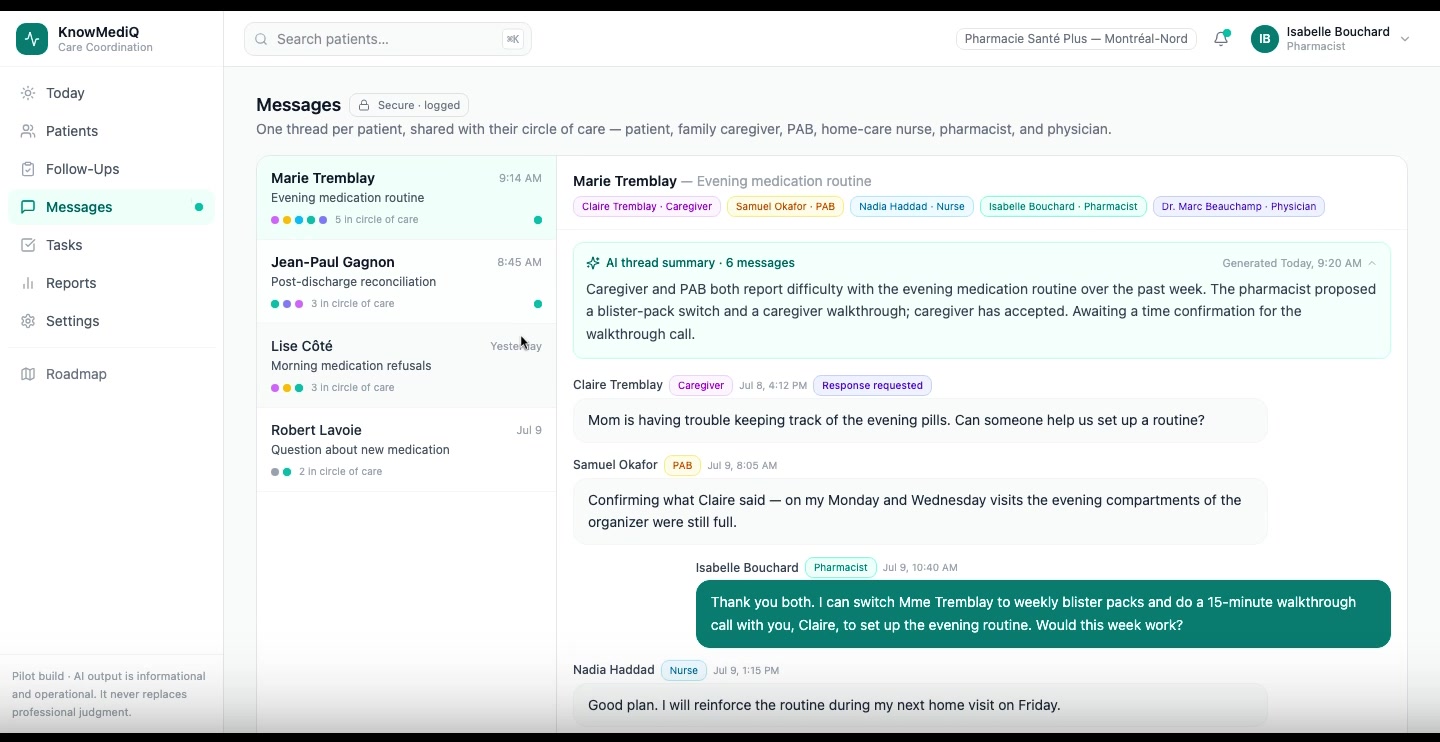
For some patients — particularly older adults or people managing complex medication routines — an authorized family caregiver may hold important practical context about medication use, symptoms or barriers at home.
With patient consent, KnowMediQ can support caregiver participation within the follow-up workflow while keeping the pharmacist responsible for professional assessment and decisions.
Real-world validation
KnowMediQ has a signed pilot with a community pharmacy in Montréal to evaluate how the AI Care Concierge fits into real pharmacy follow-up workflows.
Can appropriate patients be enrolled without creating unnecessary workflow friction?
Do enrolled patients respond to structured follow-up?
How consistently are configured follow-up interactions completed?
What types of medication, symptom, adherence or navigation concerns emerge?
Can the work queue and summaries help pharmacists review follow-up efficiently?
When appropriate and consented, does caregiver participation add useful context?
When physician input is needed, can structured context and clear next steps support more efficient communication between the pharmacy and treating clinician?
The purpose of the pilot is to generate evidence from real pharmacy workflows before making broader claims about operational or clinical impact.
Implementation principle
KnowMediQ is being validated with workflow fit in mind: structured follow-up should support the pharmacy team without creating unnecessary duplicate steps or disconnected communication.
Begin with clearly defined patient groups or care moments rather than trying to automate every interaction.
Routine outreach and organization happen around the workflow; professional decisions remain with the pharmacist.
Pilot data and pharmacy-team feedback guide how workflows should evolve before broader deployment.
KnowMediQ helps organize follow-up and surface relevant information. It is not intended to perform or replace the clinical assessment that belongs to the pharmacist.
Learn how the AI Care Concierge worksFAQ
The appropriate population depends on the pharmacy and pilot objectives. Examples may include patients starting a new medication, patients requiring a planned post-discharge check-in, or patients for whom structured adherence follow-up is appropriate.
The workflow is designed to organize the information and surface situations that may require pharmacist attention. The pharmacist remains responsible for assessing the situation and deciding what action is appropriate.
The goal is to structure routine follow-up and help pharmacy teams focus manual attention where it may be most useful. Pilot validation will determine where the workflow meaningfully supports — rather than duplicates — existing pharmacy processes.
With appropriate patient consent, an authorized caregiver can participate in relevant communication or follow-up workflows when caregiver involvement is appropriate.
Integration requirements depend on the pharmacy environment. The current pilot is being used to understand workflow and implementation needs. KnowMediQ does not publicly claim an integration unless it has been specifically implemented and validated.
Yes. The AI Care Concierge is designed around configurable follow-up pathways so the workflow can reflect the care moment and implementation objectives.
Request a demo and tell us about your pharmacy, workflow and the type of follow-up you want to improve.
Explore a pharmacy pilot
Show us where medication follow-up becomes difficult in your pharmacy. We’ll explore whether a focused KnowMediQ workflow could fit the problem.